A Q&A with Sustainability Project Manager Camille Chevalier
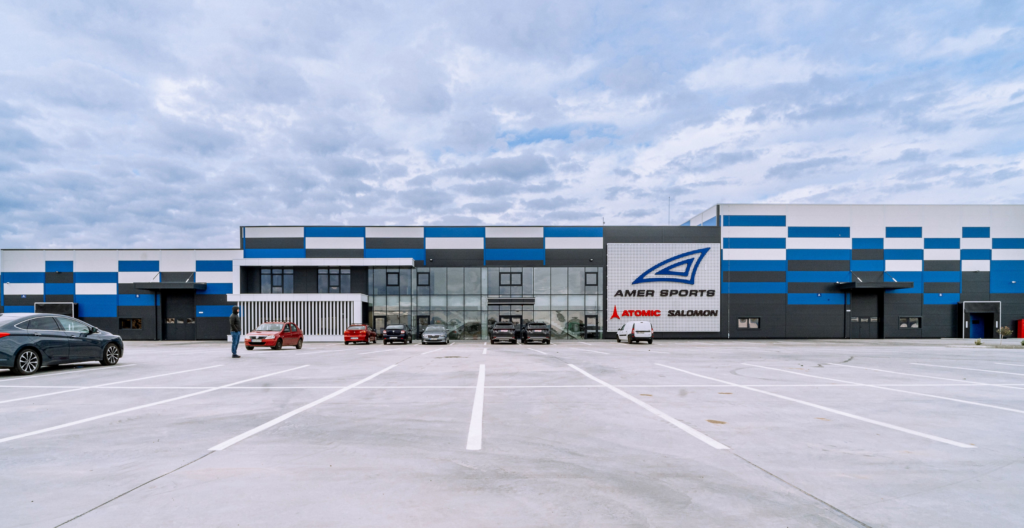
At Amer Sports, many improvements start with a simple question and grow through collaboration. One such example is a project to simplify and standardize packaging for ski bindings across Salomon, Atomic, and Armada at our production facility in Oradea, Romania — showing how environmental and economic responsibility can go hand in hand through reduced material use and greater efficiency. We spoke with Camille Chevalier, Sustainability Project Manager, about what the team found and what changed as a result.
Q: What triggered the bindings packaging project?
The project started from a very practical point. Two robots that had been used in goggles production were no longer needed, and we began exploring whether they could be reused. That led us to look more closely at how bindings were packaged overall. As we reviewed the system, it became clear that packaging had become quite complex over time and that there was room to simplify it.
Q: What did you learn once you looked at the packaging in detail?
Over time, we had ended up with several packaging types, many with quite similar dimensions. This highlighted opportunities to optimize cardboard use, reduce packaging weight, improve palletization efficiency, and simplify processes.
Q: What changed as a result of the project?
By working closely across industrialization, production, purchasing, and development teams and with our packaging supplier, we reduced the number of packaging formats by nearly 70%, from 15 box types to five standardized formats. Today, around 80% of our bindings fit into three standard sizes.
The redesign also reduced packaging volume by around 33%, mainly through lower cardboard usage and smaller box sizes. This improved how the packages fit on pallets, allowing more binding pairs to be loaded per pallet and resulting in a 61% increase in pallet efficiency.
Based on a simplified life‑cycle assessment (LCA), the environmental impact of the packaging materials alone was reduced by 21.7% compared to the previous packaging system.
We also moved packaging sourcing closer to the assembly site, which helped shorten transport distances. Together, these changes made packaging, transport and handling more straightforward and consistent.
Q: What’s the main takeaway from this project?
One of the main learnings is that even very familiar processes can hide a lot of complexity. Packaging often looks simple, but once you factor in product variation, production flow, and logistics, small differences add up quickly. This project showed the value of stepping back and looking at the system as a whole. Involving the right teams from the start was key to making changes that worked in practice, not just on paper.